About Us
Truck Tire Wheel Hub Analysis
Views : 771
Update time : 2025-07-25 14:14:00
I. Definition and Function of Wheel Hubs
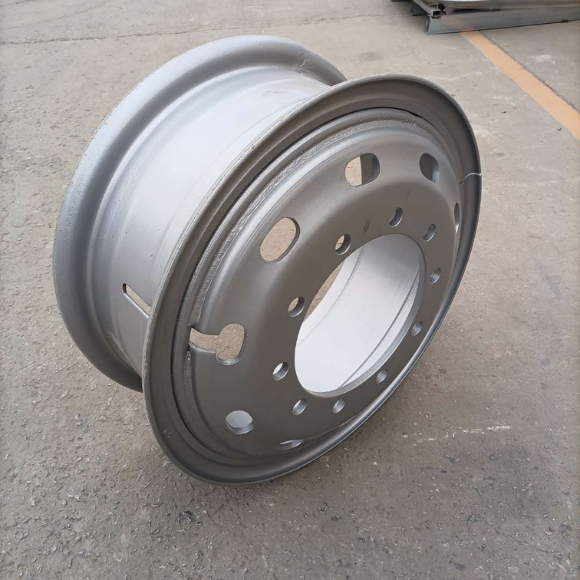
- Definition: A cylindrical metal component that supports the tire on the inner contour, with the center mounted on the axle.
- Functions: Bear the weight of the vehicle and cargo, transmit gravity to the tires; withstand road impact and friction to ensure tire stability; serve as the installation base for the braking system, affecting braking performance.
II. Types of Wheel Hubs
(I) Classified by Structure
- Deep-groove rim: Integral type with a deep groove in the middle, mostly used for cars and light off-road vehicles, rarely used for trucks.
- Flat-base rim: Commonly used for domestic trucks, with an integral retainer ring fixed by an open elastic lock ring, such as Dongfeng EQ1090E and Jiefang CA1091 vehicles.
- Split rim: Composed of inner and outer parts connected by bolts, easy to disassemble and assemble, such as Dongfeng EQ2080 and Yan'an SXZ15O vehicles.
(II) Classified by Material
- Steel wheel hub: High strength, low price, ensuring load capacity; but heavy, poor heat dissipation, prone to rust, requiring regular maintenance.
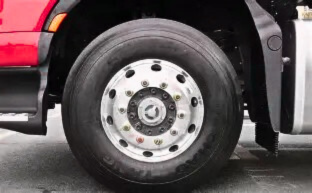
- Aluminum alloy wheel hub: Lightweight (a 22.5-inch one is 23-25kg lighter than a steel one, 22 can reduce weight by half a ton), good heat dissipation (thermal conductivity is 3 times that of steel), high manufacturing precision, strong corrosion resistance, and diverse appearances; load-bearing capacity and durability are slightly inferior to steel, suitable for standard load transportation.
- Other material hubs: Magnesium alloy hubs are lightweight with good heat dissipation and shock absorption; carbon fiber composite hubs have excellent vibration and noise reduction, but high cost, rarely used in trucks.
III. Size Specifications of Wheel Hubs
- Common sizes: 16, 17, 18, 20, 22.5, 24.5 inches, etc. Small trucks mostly use 14-16 inches, medium-sized ones 16-18 inches, and large ones 18 inches and above.
- Composition: Bead diameter and bead width, e.g., 11.00R20 for large truck ordinary tires is suitable for 16-inch hubs, and 12R25 vacuum tires have a rim outer diameter of 20 inches.
- Key parameters: Bolt circle diameter (PCD), etc., need to match the vehicle; otherwise, it will affect stability and component life.
IV. Manufacturing Processes of Wheel Hubs
(I) Steel Wheel Hubs
- Process: Steel plate pressing → butt welding → slag removal → flaring, rolling → air tightness inspection → drilling.
- Characteristics: Many steps, low technical content, easy cost control.
(II) Aluminum Alloy Wheel Hubs
- Traditional casting: Molten aluminum poured into molds and cooled to form, high efficiency, can make complex shapes, but prone to pores and low strength.
- Cast spinning: First cast the blank, then spin the rim edge, better performance than traditional casting, lower cost than forging.
- Forging: Apply strong pressure to aluminum blanks to shape them, with dense internal structure, light weight and high strength, complex process and high cost; distinguishable by "FORGED" logo or whether there are extrusion marks on the back of the rim.
V. Selection and Maintenance of Wheel Hubs
(I) Selection
- Basis: For heavy loads, choose steel or forged aluminum alloy hubs; for high-speed standard loads, aluminum alloy hubs are better; consider cost (steel is low, aluminum alloy may have higher long-term benefits); size specifications and parameters must match the vehicle and tires, choose regular brands (e.g., Hongxin, Dicastal, Meika).
(II) Maintenance
- Regular inspection: Check appearance (deformation, cracks, etc.), bolt tightness; for steel hubs, pay attention to rust removal.
- Cleaning and maintenance: Clean with special cleaners, avoid sharp tools; aluminum alloy can be waxed or coated.
- Driving habits: Avoid violent collisions and sudden braking, slow down when passing potholes or speed bumps.
相关新闻